Category: News

  • FileMaker 2025! Explore the new features

    FileMaker 2025! Explore the new features

    [vc_row bg_color=””][vc_column][vc_column_text]
    Claris has just announced the release of FileMaker 2025 (the commercial name for version 22).
    As usual, this article will walk you through what’s new and offer a critical perspective—both to help analyze the direction Claris is taking and to help you better understand the changes.

    Key points to consider

    Let’s start with a few important notes you should read before upgrading.

    • FileMaker Server 2025 only allows connections from FileMaker Pro 2024 (21) and 2025 (22). So be careful if your deployment still includes older versions.
    • Starting with version 22, major updates will now be supported via in-app updates, making it easier to keep client machines up to date.
    • Very important—and likely to complicate transitions if you’re working with a mix of versions: on Windows, it is no longer possible to install FileMaker Pro 2025 alongside older versions. FileMaker Pro 22 is expected to replace previous installations. (I haven’t tested this myself, so feel free to share your experience to clarify this point.)
    • If you’re using OData, consider waiting before updating your server. While there are significant improvements, some changes may break existing integrations (see the section on FileMaker Server at the end of this article).

    This is also the first time the Mac and Windows versions of the user interface diverge. On macOS, the developer interface now more closely resembles Apple’s own apps—like Keynote, Pages, or Numbers (more details on that below). But even the end-user interface is affected, with a new toolbar design. Frankly, I don’t quite understand why the icon set wasn’t updated on Windows too—for the sake of consistency.
    [/vc_column_text][/vc_column][/vc_row][vc_row bg_color=””][vc_column][vc_column_text]

    AI, AI, AI

    Already a major theme in version 21 (and let’s not forget that AI has been part of FileMaker since version 19 in 2020 via CoreML), artificial intelligence takes center stage in FileMaker 2025.

    I won’t go into all the implementation details here—there are numerous new functions and script steps. For an in-depth look, I still recommend reading the offficial release notes from Claris. But overall, here’s what stands out:

    • FileMaker 2025 continues in the same direction as version 21, prioritizing end-user interaction with data, rather than an “agentic” approach where AI would assist the developer by generating code or interfaces.
      Personally, I think this is the right strategy—after all, FileMaker’s “code” is already so fast to produce.
      That said, the major improvements in the XML representation of files (notably when saving a copy as XML) and the enhanced Upgrade Tool integrated into FileMaker Server suggest Claris is actively preparing for some form of developer assistant down the road.

    The main new AI features include:

    • RAG (Retrieval-Augmented Generation): limits LLM responses to data from a specific corpus (your documents, website, etc.), improving accuracy and reducing hallucinations

    • Semantic search, including text and image search—on the server side

    • Natural language to SQL query generation

    • Model hosting directly within FileMaker Server, with some models even bundled with the FileMaker Pro installer for even easier deployment

    That last point is worth discussing. FileMaker Server now includes a new admin console tab where you can enable locally installed AI models. While this is impressively simple to use, resource management is a real concern. Currently, there’s little to no way to control how much memory or GPU capacity is used by the models versus the FileMaker Server itself.
    Unless you’re running on powerful local hardware—like a Mac Studio with plenty of RAM and VRAM—you risk slowing down your entire deployment. We can probably expect Claris to allow offloading AI processing to a secondary machine in the near future, much like what’s already possible with WebDirect.

    For now, most hosting providers—including our own fmcloud.fm—have chosen to disable this AI tab by default and only enable it in custom configurations.

    [/vc_column_text][vc_column_text]

    French Localization Revisited

    It’s a minor point, but worth mentioning nonetheless: I had the opportunity to suggest improvements to Claris regarding several unnecessary translations and abbreviations in the French interface.

    Many of these changes have now been implemented, leading to a more consistent and clearer UI. Most of them will feel completely natural—you probably won’t even notice.

    However, I’d like to draw your attention to two specific functions: ObtenirTexteDynamique and ObtenirTexteDynamiqueEnJson.
    These now use TexteDynamique instead of TexteEnDirect, in order to align with Apple’s translation of Live Text.
    This change makes sense in context—but if you’re used to the old naming, you might spend a while looking for them.

    [/vc_column_text][vc_column_text]

    Found Set Navigation

    A major new feature: the ability to store and restore a list of records using their internal Record IDs, as returned by the Get ( RecordID ) function.

    The new GetRecordIDsFromFoundSet ( type ) function returns either a text string or a JSON array of record IDs, depending on the type parameter.

    [/vc_column_text][ish_table header_bg_color=”color2″ border_color=”color5″]

    Parameter value Result Format
    0 list of IDs separated by carriage returns – ¶ or Char (13): 75¶76¶77¶78¶79¶81¶83¶87¶88¶89
    1 JSON array of IDs as strings (I don’t really see the point)
    2 JSON array of IDs as numbers
    3 list of intervals separated by carriage returns: 75-79¶81¶83¶87-89
    4 JSON array of intervals

    [/ish_table][vc_column_text]

    Key points to remember:

    • The function returns an immediate result—it does not interact with the data layer. No data is downloaded between the server and the client.

    • Sort order is preserved, but no contextual information is included (no table, no layout, and no sort criteria—records are in the correct order, but the criteria used to sort them are not retained).

    • There’s no built-in function to convert between a list (or array) of IDs and a compact interval-based format, and vice versa. You need to choose your format at the time of storing the record set:

      • For lightweight storage or simple restoration, the interval format is much more efficient.

      • But if you plan to use the Go to Related Records script step later, you’ll need the full list of Record IDs.

    Restoring a found set is done, logically, via the new Go to list of records script step. It accepts any variant of the result from the function mentioned above and lets you specify the target layout and open a new window if needed.

    Error handling and behavior have been aligned with the Go to Related Records script step for consistency.

    Important note: If the sort order was custom—either because the found set had been sorted originally, or because the order was manually constructed (e.g. "3¶1¶2"), which allows for orders that couldn’t be achieved via standard sorting—then the restored found set will be semi-sorted.
    Why? Because FileMaker cannot reconstruct the sort criteria, so it cannot actually perform a sort. This means:

    • Sub-summary based on sort order layout parts will not display, and

    • The GetSummary function will not return expected results.

    Why does this matter?

    • Combined with Perform Script on Server (PSoS) and transactions, this makes it much easier to delegate the processing of a found set to the server.

    • You can store and restore multiple found sets, which opens up powerful use cases like maintaining a navigation history.

    • While it doesn’t offer all the features of a snapshot link (e.g., sort metadata, warning if records are deleted), you can pass found sets between users or processes—even in WebDirect, with no need for file system access.

    Bonus: Here’s a custom function to enhance this capability by embedding additional metadata alongside the found set…

    [/vc_column_text][vc_column_text]

    Replace Field Contents Without Triggering Auto-Enter

    To me, this is the most groundbreaking new feature in FileMaker 2025. It’s been at the top of my feature request list for a long time.
    You can now—exclusively within a script—choose to bypass auto-enter options when using Replace Field Contents.

    Use cases:

    • After migrating data from a legacy system: clean up or correct values without altering modification timestamps

    • Populate a new field across existing records, without interfering with calculated fields, timestamps, or modification tracking

    Pro tip:
    If you use a developer custom menu set, consider replacing the default Replace Field Contents command with a script that only includes that step. This way, you—as a developer—can decide whether to check or uncheck the Perform auto-enter options box.

    Note:
    We now have three script steps that can bypass auto-enter behavior:

    1. Import Records

    2. Open Transaction

    3. Replace Field Contents

    [/vc_column_text][vc_column_text]

    JSONParse

    This new calculation function allows you to store not just the usual text representation of a JSON object or array in a variable, but a true parsed JSON object, enabling much faster processing (and I really mean much faster).

    Example use case:

    Let’s say you have a JSON array stored in $json and you want to loop through its elements—either via script or using the While function.

    Set Variable [ $json ; JSONParse ( $json ) ]

    This keeps $json unchanged when used with text or numeric functions (e.g., Length ( $json ) or Left ( $json ; 1 )),
    but it now also contains a fully parsed JSON object, which significantly speeds up calls to JSON functions like JSONGetElement.

    Additionally, the new JSONParsedState ( $json ) function lets you check whether $json holds a parsed object or array—and tells you the type: 3 (object), 4 (array)

    [/vc_column_text][vc_column_text]

    Insert Text: Length Limit Removed

    Now that the target of the Insert Text script step can be a variable, this step has become popular again—since it allows you to define a text constant without invoking the calculation engine, meaning no need to escape quotes or carriage returns.

    However, the 30,000-character limit used to be a constraint. That’s now resolved: the new limit is 250,000,000 characters (yes, two hundred and fifty million).

    Note: If you’re using the MBS plugin on macOS, make sure to update it—very large variables could cause crashes. (In any case, keeping the plugin up to date is always a good idea.)

    [/vc_column_text][vc_column_text]

    Folders for Custom Functions

    Along the same lines, you can now organize custom functions into folders.
    Unfortunately, this new feature comes at the expense of something I consider essential: the ability to sort functions alphabetically or by creation order.

    The newly added search field only partially compensates for the lack of sorting.

    More critically, creating folders in FileMaker 2025 (version 22) makes the custom function list unreadable in earlier versions. Combined with the fact that FileMaker 2025 can no longer coexist with previous versions on Windows, this poses a serious compatibility concern.

    Besides, the custom function management window design is far from perfect.
    We’re back to old-school rectangular buttons that are -to my knowledge- only used in the Manage Layout dialog, but not even using the same margin, font size…
    (For comparison: manage layouts window on the left, custom functions window on the right.)

    [/vc_column_text][vc_column_text]

    Script Workspace: Collapsible Code

    You can now collapse and expand sections of code in scripts—particularly for script steps that introduce indentation, such as If, Else, End If, Loop, Open Transaction, and so on.

    Note: Regarding indentation—disabled script steps no longer affect indentation, making scripts easier to read when some steps are turned off.

    [/vc_column_text][vc_column_text]

    More Powerful SQL

    Numerous improvements have been made to the SQL engine used via ODBC or through plug-ins, as well as the ExecuteSQL function. Thanks to an updated underlying library, you can now use features such as intervals, IN clauses, and even ALTER statements.

    This means, for example, you can now rename a field using a plug-in capable of executing SQL (like MBS or BaseElements) along with an ALTER query.

    The addition of FETCH NEXT also makes it easier to implement pagination systems.

    Another enhancement is the introduction of a new system table: FileMaker_ValueLists.
    This allows you to query non-relational value lists, along with their individual values via dynamically generated tables like:
    FileMaker_ValueList_{ValueListName}.

    [/vc_column_text][vc_column_text]

    Extract Text from a PDF

    A new calculation function allows you to extract text from a PDF stored in a container field.

    Note: this isn’t magic or OCR—it simply extracts the text layer already present in the PDF. And that’s already a very welcome addition.

    [/vc_column_text][vc_column_text]

    Improvements to the Manage Database Dialog

    The updated interface brings a few new features:

    • Just like with fields, you can now add comments at the table level. Nice!
      …Except Claris forgot to give us a corresponding calculation function to access them.
    • The return type of calculation fields is now displayed in the field list—finally!
      Unfortunately, the icon to the left of fields in the calculation editor still doesn’t reflect the data type. But hey, it’s a start.

    [/vc_column_text][vc_column_text]

    Layouts

    When modifying the database structure, changes are automatically reflected in layouts.
    Previously, you could configure the app to prevent new fields from being added to the current layout. Now, you can go a step further and disable all automatic layout updates—no new fields, no label changes, and no auto-generated layouts for new tables.

    But the real treat—the small feature you’re going to love—is this:
    You can now add objects to a group without ungrouping it (and thus without losing hide conditions or other settings). This can be done via the menus, or more intuitively through the Object panel.

    Naturally, the reverse is also possible—you can now remove objects from a group just as easily.

    [/vc_column_text][vc_column_text]

    Windows-Specific Improvements

    Two major improvements on Windows, in my opinion:

    • The Send Mail script step (using the default email client) should now work properly with all email clients—including Thunderbird—not just Outlook. And for Outlook users, compatibility issues with recent versions should finally be resolved.

    • If the user is connected to the local network via Entra ID, the Web Viewer will inherit that authentication. This is a significant improvement for scenarios where an internal web app requires authentication.

    [/vc_column_text][vc_column_text]

    macOS-Specific Improvements

    There’s a lot to cover in this section. As mentioned earlier, Claris is aligning more closely with its parent company, Apple—and it was about time that this alignment translated into the user experience.
    For a cross-platform product like FileMaker, it was problematic that Mac users would feel lost in an interface that didn’t reflect macOS conventions.

    Here are the most notable changes:

    • The system accent color defined in macOS settings is now applied to FileMaker dialogs.

    • The design of the left and right panes (fields/objects/add-ons on the left, inspector on the right) has been completely reworked. Personally, I find myself scrolling more in the inspector—but the visual refresh is still welcome.

    • The Table view now offers new options for a much cleaner visual result.
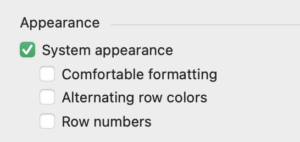
    • The Launch Center has been redesigned. Be aware: removing a favorite or recent file isn’t very intuitive—you have to select it and press Delete on the keyboard.

    • And perhaps most importantly, the toolbar has been overhauled: new icons, full customization of individual toolbar elements, and the removal of colored icons for layout mode toolbar.

    [/vc_column_text][vc_column_text]

    FileMaker Server

    As mentioned earlier, most of the big changes on the server side revolve around AI: semantic search on the server, RAG (Retrieval-Augmented Generation), and local model execution.

    Significant improvements have also been made to OData, especially around aggregation functions (including AS). This means you can now fully control the response shape—for example, by concatenating first and last names and returning it as fullName.
    For now, though, these aggregation functions only apply to the $select portion of the query—not to $filter (the SQL-equivalent of WHERE). That remains, in my view, the main reason to continue using ODBC. Hopefully a future update will address this.
    On a positive note, issues with special characters introduced in version 21 have now been resolved.
    ⚠️ Important: a significant change has been made to how ROWID is returned, which may require you to update your parsing logic. I must admit, this design choice caught me by surprise.

    Installing and updating an SSL certificate via Let’s Encrypt is now extremely easy (something our service, fmcloud.fm, has been doing for a long time).

    You can now define the WebDirect home page from both the Admin Console and the Admin API.

    In WebDirect, users are now shown a warning before leaving the app when they click the browser’s Back button.
    Finally—no more needing to rely on Romain Dunand and Ceydrick Valentini’s clever workaround.

    From FileMaker Pro, you can also disable the context menu on container fields for WebDirect users.

    That’s it for this initial tour!
    I hope this helped you get a quicker handle on what FileMaker 2025 brings.
    Feel free to share your thoughts or questions in the comments below.

    [/vc_column_text][/vc_column][/vc_row]
  • My Own Private FileMaker 21.1

    My Own Private FileMaker 21.1

    [vc_row bg_color=””][vc_column][vc_column_text]Exactly two years ago, at the first EngageU conference in Malmö, Matt Navarre organized a panel discussion and was kind enough to invite me to participate.

    In the presence of Brad Freitag, CEO of Claris, and Robert Holsey, FileMaker Product Manager, I suggested that Claris could devote a small portion of its resources to revisiting some longstanding issues that frustrate developers and that wouldn’t require complex development work.

    Brad and Robert immediately responded and understood, and over the past two years, I’ve had the chance to work more closely with them, especially with Rick Kalman, who organized this framework, as well as with David McKee and others. On my end, I reached out to the developer community to gather their ideas on priorities, and on the other, I shared this feedback with the Claris teams.

    Much of what’s new in version 21.1 stems from this process, though not exclusively.

    So, in this version 21, there are major new features, as well as these “little changes that seem insignificant”—some are simply about improving developer comfort, while others are true game-changers. And there are also no fewer than 309 fixes!

    Let’s start with these small improvements, and we’ll end with the real new features.

    First, my favorite, which goes far beyond a minor enhancement:

    Ignore Auto-Entry Options

    [/vc_column_text][/vc_column][/vc_row][vc_row bg_color=””][vc_column width=”1/2″][ish_image image=”101632″ size=”full” align=”center” show_caption=”yes”][/vc_column][vc_column width=”1/2″][ish_image image=”101630″ size=”full” align=”center” show_caption=”yes”][/vc_column][/vc_row][vc_row bg_color=””][vc_column width=”1/1″][vc_column_text]Yes! We can finally write to the database without triggering auto-entries. Until now, the only way to achieve this was through an import, but that was extremely complicated and not dynamic, unless you resorted to very complex techniques for standard development.

    However, keep in mind that while this option is very powerful, it can also compromise basic audit log techniques. So, if the integrity of your data relies on auto-entries, be careful to remove script editing privileges from users (though, realistically, if they had this privilege, they could already alter the data using an import).[/vc_column_text][/vc_column][/vc_row][vc_row bg_color=””][vc_column width=”1/1″][vc_column_text]

    Default Theme

    Finally! It’s now possible to set a default theme for a file (via File > Manage > Themes). This means creating a new layout will no longer bring back the Aqua Blue theme. This is an important step toward the ultimate goal: for FileMaker to no longer be an unattractive product.[/vc_column_text][vc_column_text]

    Column Width Retention in Developer Interfaces

    We’re still wondering what you’ll do with all the time you’ll save, now that you won’t have to keep resizing columns in tables, fields, value lists, custom functions, and more…[/vc_column_text][vc_column_text]

    Default Values in Script Steps

    Oh, I’m thrilled about this! All those script steps with absurd default values are finally getting some logic. Now, any script steps with options to open a dialog or prompt for confirmation have these options set to No by default—except for critical actions like Truncate Table, Delete Record, Delete Portal Row, and Delete All Records.

    When writing a script, the goal is usually maximum automation, with user intervention as the exception. For example, setting Commit Record to No by default—an option that hardly anyone uses—makes it immediately server-compatible (for scripts run on the server).

    One minor wish: I would have loved it if Enter Find Mode also had Pause set to No by default, but I guess that would’ve been too perfect.

    The best news of all: Go to Next/Previous Record now has Exit After Last set to Yes by default. The same applies to the corresponding action for portal rows. Say goodbye to those endless loops due to oversight![/vc_column_text][/vc_column][/vc_row][vc_row bg_color=””][vc_column width=”1/1″][vc_column_text]

    Now, let’s move on to the major new features in this version. And there are plenty!

    First, let’s highlight full compatibility with the latest macOS: Sequoia.

    PSoSoS

    Perhaps the most significant new feature: Perform Script on Server is now… server-compatible. This means you can trigger parallel actions on the server. When working with this feature, choosing the right host is crucial—and here’s some great news for our hosting service, fmcloud.fm. According to tests by Nick Lightbody, our architecture supports four times as many server script sessions as traditional services.

    I’ll also take this opportunity to let you know that you can request the update for your fmcloud.fm server right now. While you’re at it, you’ll get to explore our new console, packed with very handy features.

    This update marks the well-deserved retirement of our famous FMSDIFM, which we introduced 13 years ago.[/vc_column_text][vc_column_text]

    End of Bandwidth Limit for OData and Data API

    If you’re hosting your own server or using a third-party hosting service instead of Claris’s own FileMaker Cloud, the traffic limit has been lifted. Finally! It made no sense to charge for access to your own data on your own server. Plus, it introduced uncertainty around the actual cost of the platform. With these limits removed, you can go all-in on OData!

    (On that note, I’ll be presenting a session on OData in just 10 days at the EngageU conference in Malmö. Hurry and register!)[/vc_column_text][/vc_column][/vc_row][vc_row bg_color=””][vc_column width=”1/1″][vc_column_text]

    AI: Cohere and Semantic Image Search

    The biggest breakthrough introduced by FileMaker 21 is undoubtedly the integration of artificial intelligence.

    Version 21.1 takes these capabilities even further by adding Cohere as an alternative to OpenAI.

    Additionally, semantic search can now be applied to images! This unlocks some truly exciting possibilities![/vc_column_text][/vc_column][/vc_row][vc_row bg_color=””][vc_column width=”1/1″][vc_column_text]

    Open Quickly improvements

    I’m a huge fan of this feature, accessible via the keyboard shortcut cmd-K (macOS) / ctrl-K (Windows). It allows developers to navigate their applications much more easily than before and to design highly efficient user interfaces.

    However, it’s true that version 21.0 had some “security” issues: it exposed too much to the end user.

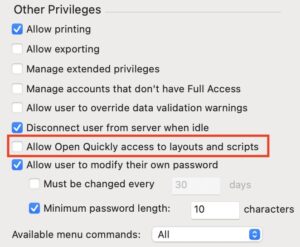
    Now, what’s displayed is logical and consistent with the visibility checkboxes for layouts and scripts, except when in Full Access mode, where everything remains accessible. Additionally, a new privilege allows you to completely disable access to Open Quickly.

    Additionally, you can now limit search results to the active file.

    Best of all, you can now activate a field, table, or table occurrence directly from Open Quickly! In this case, the Manage Database window opens with the selected item already highlighted.

    Surprisingly, value lists and custom functions aren’t (yet) included.[/vc_column_text][ish_image image=”101654″ size=”full” align=”center”][vc_column_text]

    Two small regrets (but let’s be patient…): the sorting order of results is still not ideal. I think items from the active file should appear before others.

    And it seems that a script step to open Open Quickly would allow for truly extraordinary interfaces. A single button in the UI to do it all. But we need to keep dreaming about something, right?

    [/vc_column_text][/vc_column][/vc_row][vc_row bg_color=””][vc_column width=”1/1″][vc_column_text]

    Layout Calculations: Fields Are Referenced

    Now, if you reference a field by its full name in a layout calculation (table::field), the calculation will automatically update if the field name changes.

    [/vc_column_text][/vc_column][/vc_row][vc_row bg_color=””][vc_column width=”1/1″][vc_column_text]

    Script step: Set Revert Transaction on Error (On/Off)

    It allows you to modify the behavior of transactions and prevent them from ending as soon as they encounter an error.[/vc_column_text][/vc_column][/vc_row][vc_row bg_color=””][vc_column width=”1/1″][vc_column_text]

    Constrain found set. Find without indexes option.

    When working with a table containing hundreds of thousands or millions of records, and you’ve already performed an initial selection (search), this script step now allows you to further narrow down the found set without relying on the entire table index, making it more efficient.

    Admittedly, the cases where this is useful are rare, and you could already write a loop to test each record individually, but it’s still a welcome addition.[/vc_column_text][/vc_column][/vc_row][vc_row bg_color=””][vc_column width=”1/1″][vc_column_text]

    Security: Limit References to Files Hosted on the Same Server

    A new checkbox has appeared on the fourth tab of the security dialog, allowing you to restrict references to the active file to only those files hosted on the same server.[/vc_column_text][/vc_column][/vc_row][vc_row bg_color=””][vc_column width=”1/1″][vc_column_text]

    FileMaker Server

    OData

    We’ve already discussed the removal of the traffic limit for OData and Data API, but OData is also gaining new capabilities, including the option to use aliases in queries.

    According to Claris, compliance with OData 4.01 is complete—almost! 😉 This could pave the way for a Perform OData script step in a future release, similar to what we saw with Data API.

    WebDirect: Keyboard Triggers

    The OnObjectKeystroke and OnLayoutKeystroke triggers are now supported in WebDirect but only for the Enter, Return, and Escape keys. Personally, I would have liked to see arrow keys (right, left, up, down) included as well, but they’re not.

    Admin Console

    Many improvements have been made to the console, including database subfolder management and displaying the installed Java version.

    A very useful new option now allows you, during a restart, to reopen only the databases that were open before the restart instead of reopening all databases.

    HTTPS Tunneling

    The macOS and Windows versions have been updated to include this feature, allowing connections with FileMaker Pro via HTTPS instead of port 5003. I’d like to remind you that our hosting service, fmcloud.fm, is the only one that offers a dual standard: you can have some clients connecting via HTTPS and others via port 5003.[/vc_column_text][/vc_column][/vc_row][vc_row bg_color=””][vc_column width=”1/1″][vc_column_text]

    Claris Studio et Claris Connect

    With the release of FileMaker 21.1, it’s worth noting the recent update to the Claris Studio connector in Claris Connect. This update introduces a new trigger, Create Multiple Records, along with new actions, expanding the automation and integration capabilities within the Claris platform.[/vc_column_text][/vc_column][/vc_row][vc_row bg_color=””][vc_column width=”1/1″][vc_column_text]

    If You Enjoyed This…

    If you enjoyed this article, please visit the Claris website by clicking this button. Claris loves it when you click this button, and it’s great for your karma (and mine). Thank you!

    [/vc_column_text][ish_button el_text=”Site de Claris” url=”url:https%3A%2F%2Fcontent.claris.com%2Fcpl-q1fy25-1more|target:_blank” size=”medium” align=”center” color=”color7″ text_color=”color4″][/vc_column][/vc_row][vc_row bg_color=””][vc_column width=”1/1″][vc_column_text]

    And for Testing…

    Of course, if you set up a test server on fmcloud.fm, it’s immediately deployed in version 21.1, and you’ll receive a download link for the latest version.[/vc_column_text][ish_button el_text=”Essayer” url=”url:https%3A%2F%2Fwww.fmcloud.fm%2Fchatbot%3Futm_source%3D1mt_blog|target:_blank” size=”medium” align=”center” color=”color7″ text_color=”color4″][/vc_column][/vc_row]

  • Everything about FileMaker 2024

    Everything about FileMaker 2024

    [vc_row bg_color=””][vc_column][vc_column_text]FileMaker 2024 has just been announced by Claris!

    [/vc_column_text][/vc_column][/vc_row][vc_row bg_color=””][vc_column width=”1/1″][ish_button el_text=”See on Claris.com” url=”url:https%3A%2F%2Fcontent.claris.com%2Fclaris-filemaker2024-announce-1morething-lp|target:_blank” size=”medium” align=”center” color=”color7″ text_color=”color4″ border=”no”][/vc_column][/vc_row][vc_row bg_color=””][vc_column width=”1/1″][vc_column_text]As usual, when Claris announces a new version of FileMaker you’ll find everything you need to know on our blog, for geeks and non-geeks alike.

    Ready, set, go![/vc_column_text][/vc_column][/vc_row][vc_row bg_color=””][vc_column width=”1/1″][ish_headline tag_size=”h2″]Artificial Intelligence (AI) and Large Language Models (LLM)[/ish_headline][vc_column_text]This is of course THE most visible feature of this 2024 version, but also the most complex to explain and master. We’ll be dedicating a separate article to it. You should know, however, that it is now possible to interact with virtually all large language models such as Chat GPT (Open AI), Gemini (Google) or Llama (Meta/Facebook).

    You can use these models for semantic searches on your own data (so you can search for data by formulating queries in human language!), or ask the chart tool to graph your data.

    But it doesn’t stop there. With a little practice, you can develop your own FileMaker code generator to generate complicated calculations or functions.

    It may take a lot of time to save a little, but it’s beautiful :)[/vc_column_text][/vc_column][/vc_row][vc_row bg_color=””][vc_column width=”1/1″][ish_headline tag_size=”h2″]Open Quickly, a new way of interacting with your applications[/ish_headline][vc_column_text]For several versions now, the shortcut Cmd-option-K (macOS)/Ctrl-alt-K (Windows) has been used to change models, but only in model mode.

    Open Quickly opens up much greater possibilities, but also presents a risk that developers should be aware of.

    I recommend that you pause reading this article afterwards, take a look at your applications to see if you’re not affected, and come back to read the rest later.

    What’s it all about?

    1. the functionality is now so powerful that it also needed to be more accessible. The shortcut is therefore Cmd-K (macOS) and Ctrl-K (Windows). Opening the left panel in template mode is therefore relayed to the second level (Cmd-option-K / Ctrl-alt-K). This is quite logical
    2. Open Quickly is now available in all other modes (use, search, preview), and can activate 3 types of elements:
      1. layouts (those in the current file, if defined to be visible in the layout list, or those for which you have editing rights). If you select a layout, you go to that layout (remaining in the same mode). If you hold down the option key (macOS)/alt (Windows), the icon changes and the layout opens in a new window.)
      2. Scripts. Scripts appear in the list if they are defined to be visible in the list, or if you are logged in with an account that allows script modification.This is where the “problem” lies. If you have the right to modify scripts, you can select a script to modify it or, by holding down option (macOS)/alt (Windows), execute the script. If you don’t have this right, the script is executed. This is a fantastic feature! You can really create very efficient interfaces, but it’s extremely important not to expose scripts that can’t be executed by a user without clicking on a specific button. So review your applications to uncheck the visibility box for scripts that should not be accessible.
    3. Files (recent files and favorites are accessible). Open Quickly is also a great launcher.

    [/vc_column_text][/vc_column][/vc_row][vc_row bg_color=””][vc_column width=”1/1″][ish_headline tag_size=”h2″]JSON functions gain in power[/ish_headline][vc_column_text]A new function and a new development make working with JSON much more efficient.

    JSONMakeArray ( listOfValues ; separator ; type )

    allows you to convert a list separated by carriage returns (¶) into a JSON Array. The list being, for historical reasons, the most widespread structural element in FileMaker, this is a possibility that was really lacking and often prevented you from improving/modernizing your code without embarking on lengthy and costly refactoring.

    New operators [+] et [:]

    The new operators make it much easier to write JSON arrays.

    [+] allows you to move to the next index

    [:] allows you to stay on the same index.

    So the simple expression:

    JSONSetElement ( “”

       ; [ "contact[+].nameLast" ; "Doe" ; JSONstring ]
       ; [ "contact[:].nameFirst" ; "John" ; JSONstring ]
       ; [ "contact[+].nameLast" ; "Smith" ; JSONstring ]
       ; [ "contact[:].nameFirst" ; "Emma" ; JSONstring ]
    )

    returns:

    {
       "contact" :
       [
          {
             "nameFirst" : "John",
             "nameLast" : "Doe"
          },
          {
             "nameFirst" : "Emma",
             "nameLast" : "Smith"
          }
       ]
    }

    The [:] operator can also be used to retrieve the last element of an array using the JSONGetElement function.

    GetLiveTextAsJSON

    is a new function reserved for Apple operating systems (whether FileMaker Pro, FileMaker Go or FileMaker Server) which, like GetLiveText, allows you to retrieve the text contained in an image, but this time in JSON.[/vc_column_text][/vc_column][/vc_row][vc_row bg_color=””][vc_column width=”1/1″][ish_headline tag_size=”h2″]Execute FileMaker Data API can now do Write operations[/ish_headline][vc_column_text]The Execute FileMaker Data API script step is now capable of writing to the database, and therefore precisely of creating a new record, modifying or duplicating records, and of course deleting them.

    It is now possible to perform (almost) any operation on the database from within a FileMaker script, without changing context.

    Advantage or disadvantage? since the Data API works in another session, modifications made in this way do not trigger any script (triggers), nor are they taken into account in the OnTransactionWindow event… on the other hand, this means you can write to the database independently of the current transaction.[/vc_column_text][/vc_column][/vc_row][vc_row bg_color=””][vc_column width=”1/1″][ish_headline tag_size=”h2″]Revert transaction in subscripts[/ish_headline][vc_column_text]About transactions… one of the weaknesses of implementing script transactions was that the entire transaction had to take place in the same script.

    Although this doesn’t fundamentally change, the Revert transaction script step can now be in a sub-script, which alleviates the problem.[/vc_column_text][/vc_column][/vc_row][vc_row bg_color=””][vc_column width=”1/1″][ish_headline tag_size=”h2″]Server side scripts (PSoS), callback and notifications[/ish_headline][vc_column_text]These are improvements, but not the least of them:

    When running a script on a server, you can now call the callbak script by name. What’s more, notifications (Configure Local Notification) now work on Pro (macOS and Windows). We wondered why this wasn’t the case, but here it is. It’s now easy to run a script on a server and get a notification on your Mac/PC screen when it’s finished.

    What’s more, it’s now possible to determine whether the callback script should resume a paused script.

    Unfortunately, although we have access to the configuration of buttons and almost every aspect of a system notification, we can’t control the icon or image. he technique outlined here by Laurent Spielmann, of 1-more-thing (2016), is therefore still useful.[/vc_column_text][/vc_column][/vc_row][vc_row bg_color=””][vc_column width=”1/1″][ish_headline tag_size=”h2″]Other improvements for FileMaker Pro[/ish_headline][vc_column_text]In addition to these new features, dozens of bugs have been resolved.

    More subtle improvements include

    • support for variable repetition numbers in file paths. So, for example, you can export data to a file whose path is contained in $var[3].
    • this is big: the engine used for conversion to/from XML/XSLT has been replaced, moving from Xeres/Xalan to libxml2/libxslt. This enables EXSLT functions to be supported. There’s no doubt that we’ll soon be seeing the emergence of some fine applications within the FileMaker framework.
    • The Web Viewer is evolving. On Windows, the installer updates WebView2 Runtime, which will prevent some applications from not running until a manual installation.
    • More importantly, Web Viewers (macOS and Windows) now support WebRTC. This means we’ll be able to integrate applications such as videoconferencing and others into our FileMaker applications.
    • Last note (there are a few other little things, but we’ve got to stop somewhere), the EPS format is no longer supported as an image on macOS. Claris thus follows Apple in discontinuing EPS support in its operating system.

    [/vc_column_text][/vc_column][/vc_row][vc_row bg_color=””][vc_column width=”1/1″][ish_headline tag_size=”h2″]How about FileMaker Server 2024?[/ish_headline][vc_column_text]FileMaker Server 2024 is not to be outdone. There are some very nice new features here too.

    First of all, there’s no change in compatibility between Pro/Go and Server. Versions 19.4.2 of FileMaker Pro and Go will still be able to connect.

    Performance enhancements

    By caching CSS (for Web Direct) and, above all, the link graph, new server sessions should open faster. This should result in faster PSoS sessions, with less overhead.

    https tunneling is now also available on macOS and Windows versions of the server. Until now, it was only available for Linux. FileMaker can now be installed anywhere. You don’t even need to open port 5003.

    Let’s Encrypt SSL certificates can now be easily installed using a supplied system script (Linux and macOS only). For your information, these certificates have been installed free of charge for some years now, if you choose to host your server on fmcloud.fm.

    Progress has been made on the “Custom OAuth” side. You can now configure the icon, and everything can be done via the Admin API.

    The Admin API adds new functionalities such as uploading and downloading database files (beware, containers don’t follow! this is logical but presents a real problem). You can also modify the contact information that accompanies email notifications.

    Administrator roles have been enhanced. Each administrator can act on his own databases, while the main administrator can act on all of them. Multiple administrators can share the same folders.

    The “Script Events” log can now be activated on the server side, thus separating the server event log from the script log.

    Also in the log section, the “Set Error Logging” script step now works for Web Direct and Data API.
    Also, TopCallStats and Statistics logs (stats.log) are now enabled by default. Please note that we anticipate that on some extremely busy configurations with large numbers of users, enabling TopCallStats may cause problems. If you notice a drastic drop in performance after upgrading to FileMaker Server 2024, consider disabling this log.

    In the admin console, the log viewer has improved too.

    The ergonomics of the “Programs” panel have been improved. For example, you can double-click to modify programs or display the columns of your choice in the list, filter the list, duplicate several programs at once…

    Finally! you can now block new connections via the admin API and the admin console. This means you can finally close files without new users connecting or reconnecting during the closing process.[/vc_column_text][/vc_column][/vc_row][vc_row bg_color=””][vc_column width=”1/1″][ish_headline tag_size=”h2″]Middle-East and Central Europe versions available on Linux[/ish_headline][vc_column_text]It’s a first! Not only are the localized versions published by Winsoft International

    for the Middle East (allowing you to design interfaces for right-to-left languages such as Arabic, Hebrew and Persian) and for Central Europe are available at the same time as the classic version, but the server is now also available for Linux.

    This means you can generate PDFs on the server, or offer your users Web Direct interfaces designed specifically for these languages.

    Of course, these versions are immediately available on fmcloud.fm, 1-more-thing’s hosting service. You’ll need the appropriate license, which we can also provide.[/vc_column_text][/vc_column][/vc_row][vc_row bg_color=””][vc_column width=”1/1″][ish_headline tag_size=”h2″]Compatibility[/ish_headline][vc_column_text]FileMaker Pro 2024 (or 21.0) requires

    • macOS Ventura 13 or higher
    • Windows 10 ou 11

    and can connect to FileMaker Server 19.4.2 and higher. (Please note that we find it hard to understand why connection to 19.4.2 is still tolerated, as it doesn’t contribute to the indispensable updating of the servers. If you absolutely must remain in FileMaker Server 19, we strongly recommend that you upgrade to FileMaker Server 19.6.4 without delay. Similarly, if you need to keep a version 20 (why? since 21 offers the same compatibility with client versions), please update your server to 20.3.2.
    At fmcloud.fm, 100% of our servers are up to date.

    FileMaker Server 2024

    • Ubuntu 20.04 LTS Server (AMD64)
    • Ubuntu 22.04 LTS Server (AMD64 or ARM64)
    • macOS Ventura 13 or higher
    • Windows Server 2019 or 2022

    Pro/Go Clients with 19.4.2 or greater can connect.[/vc_column_text][/vc_column][/vc_row][vc_row bg_color=””][vc_column width=”1/1″][ish_headline tag_size=”h2″]Where to start? Where to find FileMaker?[/ish_headline][vc_column_text]If you’re just starting out with the platform, we recommend going through the free trial our fmcloud.fm hosting service to get started.

    In less than 10 minutes, you’ll have a trial copy of FileMaker Pro and a server installed in the cloud.

    A short video explanation here.[/vc_column_text][/vc_column][/vc_row]

  • FileMaker 2023

    FileMaker 2023

    [vc_row bg_color=””][vc_column][vc_column_text]

    FileMaker 2023 is available! an in-depth exploration.

    Claris just announced the immediate availability of the new version of FileMaker, FileMaker 2023.

    It has been a long time since we published a long article about a new version of FileMaker. The main reason to that was probably that numbering system in version 19 did not give rise to much excitement. Even if some minor versions included important new features, it was difficult to draw attention to them.

    With FileMaker 2023, however, Claris sounds the clarion call. Not only the commercial name of the product changes: FileMaker 2023 and not FileMaker 20 (which is the version number), but we get a brand new icon.

    FileMaker 2023 icon

    We can always discuss the aesthetics or joke that it’s the Pac-man from the Claris logo that swallowed a FileMaker file, it’s still a nice change.
    And while we’re on the subject of logos, let’s note that Claris Connect is also getting its own.

    Icone Claris Connect

    Here comes Pac-man again, but with a bow tie.

    Makes you want to play Trivial Pursuit, doesn’t it? Well, it’s a good thing because this article will hopefully answer a lot of questions.[/vc_column_text][/vc_column][/vc_row][vc_row tag_size=”h2″ align=”” icon=”” icon_align=”left” tag=”h” bottom_margin=”” bg_color=””][vc_column width=”1/1″][ish_headline tag_size=”h2″]A version for nerds[/ish_headline][vc_column_text]I might as well say that the most spectacular aspects of this version have already been covered above (the name and the icon), because FileMaker 2023 will not make end users jump through hoops with flashy features.
    On the other hand, it will delight them because their developers or advanced users will be able to respond much more efficiently to certain problems that they had to work around with difficulty until now.

    Actually, I myself have been looking for a long time for the consistency of this version. At first sight, a patchwork of disparate evolutions, but on closer inspection, there is really a goal of consistency, stability and scalability.

    If I had to draw two “messages” to summarize the new features of this version, it would be:

    1. The FileMaker platform is alive. Some people feared that Claris Studio would take up too many resources at Claris at the expense of FileMaker and the corresponding components of the Claris platform. This version is a clear answer to these concerns, we will see why.
    2. Claris has not given up on making FileMaker a platform of its time, capable of serving larger numbers of users processing more data, and more integrated. To do this, it relies on the community of developers by providing them with tools, admittedly a little “geeky”, but devilishly interesting.

    [/vc_column_text][/vc_column][/vc_row][vc_row tag_size=”h2″ align=”” icon=”” icon_align=”left” tag=”h” bottom_margin=”” bg_color=””][vc_column width=”1/1″][ish_headline tag_size=”h2″]Note on compatibility[/ish_headline][vc_column_text]FileMaker Pro 2023 is compatible with

    • masOS Monterey or greater (Ventura, for which several issues have been fixed)
    • Windows 10 or greater

    FileMaker Server 2023 is compatible with

    • masOS Monterey or greater
    • Windows Server 2019 or greater
    • Ubuntu 20 or greater (AMD and ARM)

    On the other hand, after 4 years of maintaining the compatibility of the server with FileMaker Pro 18, it will not be able to connect to FileMaker Server 2023. So be careful. The minimum required version is FileMaker 19.4.2.

    Of course, FileMaker Pro 2023 can be connected to FileMaker Server 19.4.[/vc_column_text][/vc_column][/vc_row][vc_row bg_color=””][vc_column width=”1/1″][ish_headline tag_size=”h2″]New for the end-users (there are some!)[/ish_headline][vc_column_text]As you know, users are impatient. So let’s start with the new features that concern them directly.

    • It is now possible to read a QR code from a document stored in a container field, both on the server and on the client (FileMaker Pro/FileMaker Go). New automated document flows are therefore possible. For example, it is possible to link a document to a record automatically.
    • The LiveText feature (macOS / iOS) is now server compatible (mac OS)
    • Import of the license certificate! Finally! Double-clicking on a Claris license certificate will now start the license registration process. This will simplify the life of users and administrators.
    • Sending email with OAuth2 authentication. Yes, I agree, considering the title it could be put in the “for geeks” section, but in fact it concerns very directly the users who were confronted with the evolution of Gmail and Office 365 messaging. You can use them again directly from FileMaker.
    • Support of sFTP for the Insert from URL script step..
    • Another technical update but one that will please some users and administrators: the maximum number of files hosted on FileMaker Server is increased from 125 to 256. I bet this will be a question on the next certification exam, you will have read it here first 🙂

    Two more points on Claris Connect to please the users, and then we attack the heavy stuff.

    • This is one of the most important points: Claris Connect, the Claris automation and orchestration service (vidéo) has now a free tier.
    • FileMaker Pro has a new script step, Trigger Claris Connect Flow, that makes it extremely easy to integrate the two tools. To be honest, I can’t think of a reason why this wasn’t the case before. The fact remains that it is now possible to trigger a Claris Connect flow and get the result in a variable without any particular knowledge of cURL. This is a great way to make Claris Connect much more attractive, even for advanced developers.

    This time, it is the end of the “user” functions, the rest – the most important by far – will be…[/vc_column_text][/vc_column][/vc_row][vc_row bg_color=””][vc_column width=”1/1″][ish_headline tag_size=”h2″]…reserved for geeks, developers, and demanding administrators…[/ish_headline][vc_column_text]All right. Are we among ourselves now? Can I use a lot of acronyms and jargon?

    Don’t worry, I’ve got to squeeze in a few, but there are some great new features. Hang on, I’m saving the best for the last.[/vc_column_text][ish_headline tag_size=”h3″]FileMaker 2023, a major software update[/ish_headline][vc_column_text]This is very reassuring for the platform. A large part of the libraries and frameworks that underlie the platform have been updated, especially on the server. Java, Vaadin, Tomcat… This is an excellent sign that Claris is really working on the platform and is not just making surface advances to please marketing.

    A little surprise though: Java is updated to 17 when the most recent version is 19, but I don’t know the reasons or the implications.

    A little regret too: the WebKit embedded in the web viewer is still the same, and it’s a pity because many javascript libraries take advantage of recent evolutions. For example, our incredibly successful add-on 1MT PDF Viewer cannot integrate certain features.[/vc_column_text][ish_headline tag_size=”h3″]An ARM version and a load balancer for an ambitious strategy[/ish_headline][vc_column_text]As we have already mentioned, Claris’ strategy is to reduce the number of versions of FileMaker Server, and therefore to support only Linux.

    This is an excellent choice that we have been calling for for a long time, because it will allow Claris to go much faster in development.

    The fact remains that… not all customers run Linux. That’s why we’re probably going towards a Linux server that can be virtualized on macOS or Windows, so the user won’t see any difference.

    But many PCs, starting with recent Macs, are now running on an ARM architecture and not on x86.

    With FileMaker 2023, Claris is releasing a version of FileMaker Server for the ARM processor. According to our tests, this is not yet a miracle in terms of performance, but it is very important for the developer community to know that this version already exists and that it will be improved and optimized.

    By the way, Ubuntu 22 is now supported. This means that Claris now supports Ubuntu 20/AMD, Ubuntu 22/AMD, Ubuntu 22/ARM, and of course the macOS and Windows versions of FileMaker Server. That’s already quite a lot, but in addition the Linux versions are also declined in Claris Server (the equivalent of FileMaker Server for the new Claris platform)[/vc_column_text][ish_headline tag_size=”h3″]Load balancing, cache management and garbage collector[/ish_headline][vc_column_text]The Linux versions of FileMaker Server, which use the NginX web server, now make it very easy to install secondary servers to manage a real load balancing for Web Direct users.

    Between us, the performance we already achieve on fmcloud.fm, due to its modern Docker architecture, means that we have never, even in extreme cases, faced limitations of the web server’s capacities, but we are curious to see the impact on the most demanding applications.

    Cache management

    Version 19.6 had already made it possible to delete the client (FileMaker Pro) cache from the application preferences. Version 20 (FileMaker 2023) adds Get ( CacheFileName ) and Get ( CacheFilePath ) functions, which allow to delete the cache file by script, in order to perform performance tests without restarting the application. Yes it’s wicked geeky, but it’s really good news for the optimizations we’re fond of.

    On the server side, a new feature allows you to allocate more or less cache memory to list views on Web Direct. Specifically, it is possible to configure the number of records that Web Direct should pre-load in order to make scrolling smoother. This feature did not make its way into the admin console, don’t waste time looking for it.

    Java garbage collector

    Two features: a button to trigger the garbage collector, and the possibility to schedule this process, like running a script or, as since version 19, like cleaning the cache.

    I won’t go into the details of what garbage collection is, but it is a process that frees up memory addresses that have not been freed up by the process that allocated them. In other words, it cleans up where the developers of the server or one of its many components forgot to do so. We’re curious to see what this can improve in scenarios where the server was using more and more memory as Web Direct connections were made.[/vc_column_text][ish_headline tag_size=”h3″]More FileMaker Server 2023 features[/ish_headline][vc_column_text]I can feel it, you would like us to get to the big news, but even though they are more quiet, the ones that are coming are big news, ordered in increasing importance, according to a universal and objective point of view: mine.

    • I’ll pass on the management of canceled backups. This completes the possibility to cancel backups that appeared with FileMaker Server 19.5
    • Access to the administration console of the Linux version of the server can now be controlled by Active Directory.
    • The name of the schedules can be up to 100 characters, which is much more comfortable than the previous 31.
    • New connections are blocked when a file is in the process of being closed. Until now, closing a file caused users to log out, but if a new connection occurred during the process it could not be prevented. This is a great improvement for administrators of applications with a large number of users.
    • Data API now supports Save as PDF.
    • Log server-side scripts. Two new features :
      • the “Set Error Logging” script step is now server compatible.
      • script events are now recorded in a different log file than server events. ScriptEvent.log. Excellent news, but it may potentially require you to review your procedures, if you had automated processing on log files.
    • OData becomes very, very powerful as it can now work on related data. OData is probably the least known of the FileMaker data publishing methods, yet it is extraordinarily simple and powerful.

    [/vc_column_text][ish_headline tag_size=”h2″]The big news[/ish_headline][vc_column_text]Finally! the two main new features of FileMaker 2023.

    [/vc_column_text][ish_headline tag_size=”h3″]Perform Script on Server With Callback[/ish_headline][vc_column_text]Since FileMaker 13 it is possible to easily execute a script on the server from the client (actually since before that if you follow our adventures).

    This opened up many possibilities, with much faster and more secure processing.

    Moreover, it allowed the execution of parallel processes, the client not being forced to wait for the end of the script execution on the server. The client could therefore go about its business, or even trigger other scripts on the server, while the server was working.

    The problem was that the client had no way of being notified that the server had finished its work. We had to develop complicated messaging systems, and the client had to regularly check that no messages had arrived.

    This is now history since a new script step Perform Script on Server With Callback (PSoSWC) allows you not only to execute a script on the server, but also to have another script triggered on the client workstation when it has finished.

    This means that you can, for example, notify the user that his report is ready or that a heavy operation has been completed.

    Tip : the script result (defined in Exit script) of the server script is taken as the script parameter of the callback script..

    Regret: unlike the other two main script steps allowing to execute a script (Perform Script and Perform Script on Server), it is not possible to call a script by its name! (neither the callback script, nor even the server script). What a pity![/vc_column_text][ish_image image=”80278″ size=”full” align=”center”][ish_headline tag_size=”h3″]Window Transaction (or “audit log”)[/ish_headline][vc_column_text]As you may or may not know, audit logs have almost become a personal obsession. The main reason for this “hobby” of keeping track of data changes is probably that it is not possible in FileMaker to have a 100% reliable audit trail. A kind of Holy Grail quest. Vain but beautiful.

    Nevertheless, by developing FM AuditLog Pro, I believe I have unlocked many of the mysteries of FileMaker, understood some of the finer points of the calculation engine, security, and of course the data model and dependency tree.

    Needless to say, reading in the new features the mention of “Audit log” was enough to arouse my attention. This feature is a little wonder, but it is “low level”, and it is designed so that you can make your own log system. It is not in itself an audit log.

    Here is the principle in a few words. We are publishing simultaneously an article entirely dedicated to this feature which needs explained further.

    • There is a new trigger at the file level (File Options)
    • If this trigger is activated, any record validation or record deletion will trigger this script.
    • The script will receive a JSON parameter indicating the files, tables, records (ID) concerned, as well as the type of modification (New, Modified, Deleted)
    • Within this JSON parameter, we can add a custom parameter for each record which will be the content of a field named OnWindowTransaction. It is possible to choose another name in the file options, but this name will have to be consistent in all the tables of the file. This field can of course be calculated, to contain the name of the fields and the modified values, or other information you may want to add.
      If the content of this field is JSON, this JSON will not be converted to string.
    • Of course, the script allows to record the transactions.

    [/vc_column_text][ish_headline tag_size=”h3″]Bonus : work with Base Tables[/ish_headline][vc_column_text]In connection with the audit log, Claris provides us with a few functions for working on tables, as opposed to table occurrences.

    Everywhere in FileMaker, with a few exceptions (the Tables tab of the database definition, security, Truncate table script step), the word “Tables” refers not to tables but to table occurrences.

    The real tables appeared only in a system table, queryable with the ExecuterSQL function, FileMaker_Tables, which represents the table occurrences, but has a BaseTableName column.

    In version 19, Claris added another table: FileMaker_BaseTableFields, which looks very much like a deduplicated view of FileMaker_Fields.

    This is finally changing, with a series of new functions and SQL tables.

    • BaseTableNames ( file ) allows to list all the tables (names) of a file
    • BaseTableIDs ( file ) allows to list the IDs of these tables.
    • GetBaseTableName ( field ) is used to obtain the name of the base table of a field.
    • A new system table, FileMaker_BaseTables, has the following columns: BaseTableName, BaseTableID, Source (<Internal>, MYSQL…), ModCount.

    Unfortunately this arsenal is very incomplete. The FileMaker_BaseTables system table, as well as FileMaker_BaseTableFields which appeared in 19, do not take into account the tables of external files referenced in the relationship graph of the current file. It is therefore complex (but possible) to retrieve the ID of a table from a linked file.
    The absence of a GetFileName ( field ) function and of a GetBaseTableName ( field ) function, or even of a BaseTableID column in the FileMaker_Fields system table, does not make these requests any easier.[/vc_column_text][ish_headline tag_size=”h2″]In conclusion…[/ish_headline][vc_column_text]As we have seen, this version is full of new features (and I haven’t covered everything!), which at first sight are very disparate and form a patchwork.

    In reality, there are very strong implications. I will try to summarize them in order to get a general idea.

    • Towards a single Linux server, on ARM as on x86. Don’t panic yet, I did write “towards”.
    • A server capable of managing more applications (256), more users (load balancing) and better equipped to manage memory, even to configure it finely.
    • Increasingly powerful OData and Data APIs.
    • Tools for debugging server-side scripts.
    • Easier integration with Claris Connect, and a free tier for the latter.
    • Perform Script on Server With Callback. A great incentive to delegate even more to the server.
    • An “audit log” which makes it possible to memorize transactions and thus to be able to re-execute them on another server…

    As we can see, and in accordance with the vision we announced several years ago, the central component of the platform is increasingly the server. It is becoming easier and more efficient to design solutions in which FileMaker Pro/Go is only a de luxe front end and delegates the heavy lifting to FileMaker Server, like Web Direct. The choice of a hosting service has therefore never been so crucial. (comparison sheet on fmcloud.fm).

    I hope that this long article will help you to discover FileMaker 2023 faster and further. Don’t hesitate to share on the social networks.[/vc_column_text][/vc_column][/vc_row]

  • The Claris Excellence Award for Innovation goes to fmcloud.fm!

    The Claris Excellence Award for Innovation goes to fmcloud.fm!

    [vc_row bg_color=””][vc_column][vc_column_text]It is a great honor and pleasure for us to announce that 1-more-thing has been awarded today by Claris with the most sought-after prize: the Claris Excellence Award for Innovation

    Indeed, the jury has recognized our revolutionary FileMaker hosting service, fmcloud.fm and the fact that it is light years ahead of traditional services.

    For two years, fmcloud.fm has revolutionized practices by allowing companies of all sizes to benefit from a true cloud to deploy the FileMaker low code platform, and to gain in performance, serenity and cost.[/vc_column_text][/vc_column][/vc_row][vc_row bg_color=””][vc_column width=”1/1″][ish_headline tag_size=”h2″]A real cloud running on Linux/Docker[/ish_headline][vc_column_text]We have invested heavily to enable FileMaker Server to run on a Linux/Docker architecture, with an “architecture as code” offering extraordinary flexibility.
    We are able to deploy or upgrade thousands of servers around the world in seconds, and our customers have access to monsters of power at a price often lower than the simple cost of ownership of a local server.

    But our efforts don’t stop there. It’s a pleasure to see how Claris optimizes each release, allowing our team to optimize in turn so as to deliver ever more powerful and cost-effective solutions.[/vc_column_text][ish_image image=”15088″ size=”full” align=”center”][vc_column_text]We would like to warmly thank Claris for this award, but also, of course, the dozens of consultants around the world who rely on our FileMaker hosting service their clients’ applications and their own development environment, and who contribute to the reputation of this first-class service.

    Also special thanks to Nick Lightbody and Christian Schmitz (MonkeyBread Software, MBS) for their great reviews here and here.

    Learn more about the hosting and licensing offering and deploy your completely free trial server in just a few moments from the fmcloud.fm website.[/vc_column_text][ish_image image=”33412″ size=”full” stretch_image=”yes” link_type=”custom” link_url=”url:https%3A%2F%2Fwww.fmcloud.fm||target:%20_blank|” align=”center”][ish_headline tag_size=”h2″]And the winners of the 2021 Claris Excellence Awards are…[/ish_headline][ish_table header_bg_color=”color7″ header_text_color=”color4″ border_color=”color7″]

    Category Recipient
    Lifetime Achievement Award Cristoffer Ippolite, iSolutions
    Rising Star Award Amy Davidson, We Know Data
    Humanitarian Award LuminFire
    Innovation Excellence Award 1-more-thing for fmcloud.fm
    Claris FileMaker Excellence Award ClickWorks
    Claris Connect Excellence Award Square Moon AB
    Design Excellence Award Solis Digital
    Advocacy Excellence Award Beezwax Datatools, Inc.
    Education Excellence Award Richard Carlton Consulting Inc.
    Growth Partner of the Year — Americas DB Services
    Growth Partner of the Year — Europe Lesterius
    Growth Partner of the Year — North Asia Supportas Inc.
    Growth Partner of the Year — Asia Pacific Kamar Limited
    Community Leader of the year Jeremy Brown
    Community Development Excellence Award The Luke Commission

    [/ish_table][/vc_column][/vc_row]

  • Best Startup EU Names 1-more-thing Among The Top Data Integration Startups In Belgium

    Best Startup EU Names 1-more-thing Among The Top Data Integration Startups In Belgium

    We are thrilled to announce we have been featured in the Best Startup EU Magazine as one of the top Data Integration companies in Belgium.

    Thanks to our expertise in designing Low-Code applications and integration/orchestration, 1-more-thing was selected due to exceptional performance in the innovation category, among the following categories:

    • Innovation
      • Innovative ideas
      • Innovative route to market
      • Innovative product
    • Growth
      • Exceptional growth
      • Exceptional growth strategy
    • Management
    • Societal impact

    We are extremely happy to see Low-Code gaining visibility and allowing companies like ours to gain even more credibility. Our clients have known for a long time what the flexibility of Low-Code can do for them, and it was high time that a wider audience of businesses benefited.
    [Watch Fabrice Nordmann’s interview on BFM Business about Low Code and Digital Transformation (French)]

    About the Best Startup EU Award:

    Annually, Best Startup EU awards the most successful startups in the EU, with its lists featuring companies who are pushing the limits of innovation to solve critical problems and challenges. Best Startup EU aims to accelerate the growth of the foremost EU based companies, businesses and innovations by promoting them to a global audience. This year 1-more-thing makes this list for their exploits in the Digital Transformation industry.

    Pleased and humbled by this latest recognition 1-more-thing is ready and eager to deliver to the EU and global stage.

    Read the full article here.

    About BestStartup.eu 

    Best Startup EU is an online publication that helps promote European businesses and put them on the international stage. They primarily focus on businesses who show positive signs of growth, innovation, management and excel in areas which have a beneficial impact on society.

  • FileMaker Server on Linux: the fmcloud.fm 2.0 revolution

    FileMaker Server on Linux: the fmcloud.fm 2.0 revolution

    You have to get used to it, with the new short release cycles of FileMaker, important new features are no longer necessarily on a fixed date with a new version number. It is therefore no longer enough, for those interested in the FileMaker platform, to set aside some time in May to inquire about the new features of the annual version: one must also pay close attention to the intermediate versions.
    It is indeed in a relative discretion that Claris announced on Wednesday, October 28th a new version of FileMaker Server, the 19.1.2, which is in itself a major evolution, but which also allows hosting services to offer totally revolutionary services and performances.

    Linux!

    This is of course the big news. This version, which had been available in beta for several months, is now official. Not only is it more powerful than its cousins for mac OS and Windows, but above all it can be deployed as a docker.
    Super fast FileMaker hosting on Linux servers
    This allows hosting providers such as us – well, you still need to invest in order to switch to this kind of architecture, and it seems that we are the only ones to have done so to date (🥇) – to offer a high-performance, ultra-portable service (it can be deployed in virtually any data center in the world) and … very inexpensive. For example, this allows us to offer hosting at $59 for 5 users, where our Windows servers (for which the number of users does not influence the price, of course), start at $99.
    But this is not the place to praise our merits, it was just to give you an example. If you want to see our prices and offers, it’s this way:
    [su_button url=”https://www.1-more-thing.com/1-more-quote” target=”blank” background=”#c751587″ color=”#b60966″ size=”6″ center=”yes” radius=”0″ id=”config”]Configure my server[/su_button]
    The Linux version also brings a very interesting new feature: OData, a modern standard for processing queries to a database. Quite similar to the ODBC/JDBC gateway, but with a JSON or XML output.
    Without going into detail, here is the documentation.
    Also, AD FS authentication is available for the Linux version.
    On the other hand, an important feature of the macOS and Windows versions is not reproduced in the Linux version (or more precisely, it is disabled): custom web publishing (PHP/XML). To switch to Linux, you will have to go through Data API or OData. If you are not comfortable with this, we can help you. After migrating dozens  of applications, we’re used to it, and it’s finally a surprisingly fast process.

    Other important points (I’m saving the best for last, you have to read everything 🙂 )

    Some technical updates first of all:

    • OpenSSL 1.1.1g support
    • Compatibility with Tomcat 8.5.55
    • It is now possible to manage your license from the server administration console.

    But above all…

    • FileMaker Server updates are now real re-installations… that preserve the settings! As our hosting customers may know, we were the only ones who mastered updating with parameters preservation, which allowed us to offer our customers easy updates (a lot of tricks and mischief had allowed us to unlock the secrets of FileMaker Server ;)), but now anyone can update with confidence.
    • A new system of sharing lock allows much better performance on certain actions, notably searches and indexing.
    • Server script for checking all databases
    • Cache dump server script! (this is very interesting for very busy servers that were showing signs of slowing down after a few days/weeks without rebooting)
    • Finally, this news will be of particular interest to developers: Sorting is now done on the server when possible (when FileMaker decides on its own that it is more interesting to sort on the server, depending on the amount of data, server occupancy… you can’t control when the sorting will be done on the server or on the client). It is very efficient for sorting on a local table, but according to our tests it doesn’t work on linked records.
    As you can see, this 19.1.2 is the most important evolution of FileMaker Server in a very long time.
    I invite you to read the release notes and follow the links, it is very informative, as well as this invaluable document on performance improvements (somehow difficult to find on the Knowledge Base).
  • What a week!

    What a week!

    Well, there are weeks when things happen, things!

    Of course, the big news last week was the release of Claris Connect.

    Our videos in French and English have broken records in terms of number of views, and have been re-published by some specialized media such as

    MacGénération

    or mac4ever

    As a result, we have been awarded the “grade” of Claris Connect Partner by Claris International, which attests to the fact that we have completed the relevant training and are able to advise you effectively on the technical and commercial aspects of the Claris Connect platform.

    Marketplace

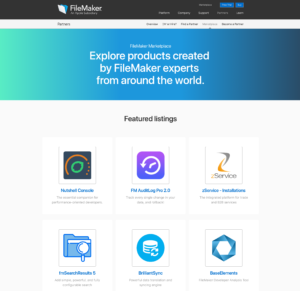
    But good news never comes alone, so two of our products occupy the top two spots in the global FileMaker Marketplace!


    #1 : Nutshell Console is a tool that installs on a FileMaker Server and makes it easy to configure and administer certain aspects of FileMaker Server that are inaccessible through the standard Administration Console. Most importantly, Nutshell Console makes it possible to draw statistics, monitor server activity, and easily detect the causes of a problem or slowdown.

    #2 : FM Audit Log 2.0 is a native FileMaker solution that developers can implement in their applications to keep track of all data changes. Compatible with FileMaker Pro, FileMaker Go, and FileMaker Web Direct, FM AuditLog Pro 2.0 also provides rollback capability.


  • Claris Connect: the new integration/orchestration platform by Claris

    Claris Connect: the new integration/orchestration platform by Claris

    Today Claris made its new integration/orchestration platform available: Claris Connect.

    During DevCon 2020 in Orlando, Brad Freitag (@bradfreitag), CEO of Claris International announced the acquisition by Apple/Claris of the Italian startup Stamplay.

    A few months later, Claris Connect is born! This new platform allows you to create and automate very complex data workflows in minutes… without any technical background.

    What was requiring several days of development to integrate various web services can now be accomplished very easily, including logic, error trapping, data transformation…

    Giuliano Iacobelli
    Giuliano Icacobelli (@Giuliano84), founder of Stamplay & Fabrice Nordmann (@FabriceN), 1-more-thing

    Watch this video by Romain Dunand (@airmoi), and enjoy!

    In this example we will integrate a WordPress powered web site with WooCommerce plugin, a FileMaker Server hosted database and Office 365. Note that Claris Connect is independent from FileMaker software, used here as an example only.


  • FileMaker launches its Marketplace

    FileMaker launches its Marketplace

    Today Claris launches its FileMaker Marketplace. Guess who got the top spot on the first page?

    Nutshell Console of course ! The flagship product of the season, cited many times during the last DevCon in Orlando.

    Beyond this sweet satisfaction, we are very excited about this FileMaker Marketplace. While there isn’t much content at this time, the quality of what is available (apps, training …), make us confident that it will contribute to expand significantly the platform’s visibility.

    We have some projects that might interest developers. If you are interested, do not hesitate to contact us or to meet us at future European conferences (scroll down the page for European conferences)

  • FileMaker Inc. becomes Claris

    FileMaker Inc. becomes Claris

    A quick note from Orlando, where 1-more-thing’s Romain Dunand and yours truly attend FileMaker DevCon’19, the annual FileMaker developer conference.

    Brad Freitag, the new CEO – who had previously held the position of sales manager for six years – made some sensational announcements at the inaugural keynote.

    The most striking is the name change of FileMaker Inc. which becomes (again) Claris (the full name is Claris International Inc.). It is important to note that the name of the product remains FileMaker, so this name change has a limited impact on our lives and those of our customers. However, this represents a great marketing opportunity and will refresh the image of our platform whilst giving it more visibility.

    Giuliano Iacobelli
    Giuliano Icacobelli, founder of Stamplay & Fabrice Nordmann, 1-more-thing.

    However, the reason for this change is extremely exciting: Claris will now have other things to sell! Indeed, Brad Freitag announced the recent acquisition of Stamplay, a startup whose technology is perfectly in line with FileMaker Software’s “Workplace Innovation Platform” positioning. Branded Claris Connect, Stamplay’s products will carry on enabling further and faster integration of all technologies and services used by companies. We are absolutely delighted with this strategy that we shall further discuss at some point.


    Devcon Keynote Nutshell Console
    Brad Freitag, CEO of Claris, presents Marketplace and … Nutshell Console

    Finally, we had the pleasure of seeing our product, Nutshell Console, honoured by Brad Freitag during the announcement of the Marketplace. Nutshell Console was also mentioned several times during the first day’s sessions, confirming its flagship position of this season’s FileMaker series. To celebrate, Nutshell is also being promoted during the conference (30% discount on the first year with code fmdevcon19)